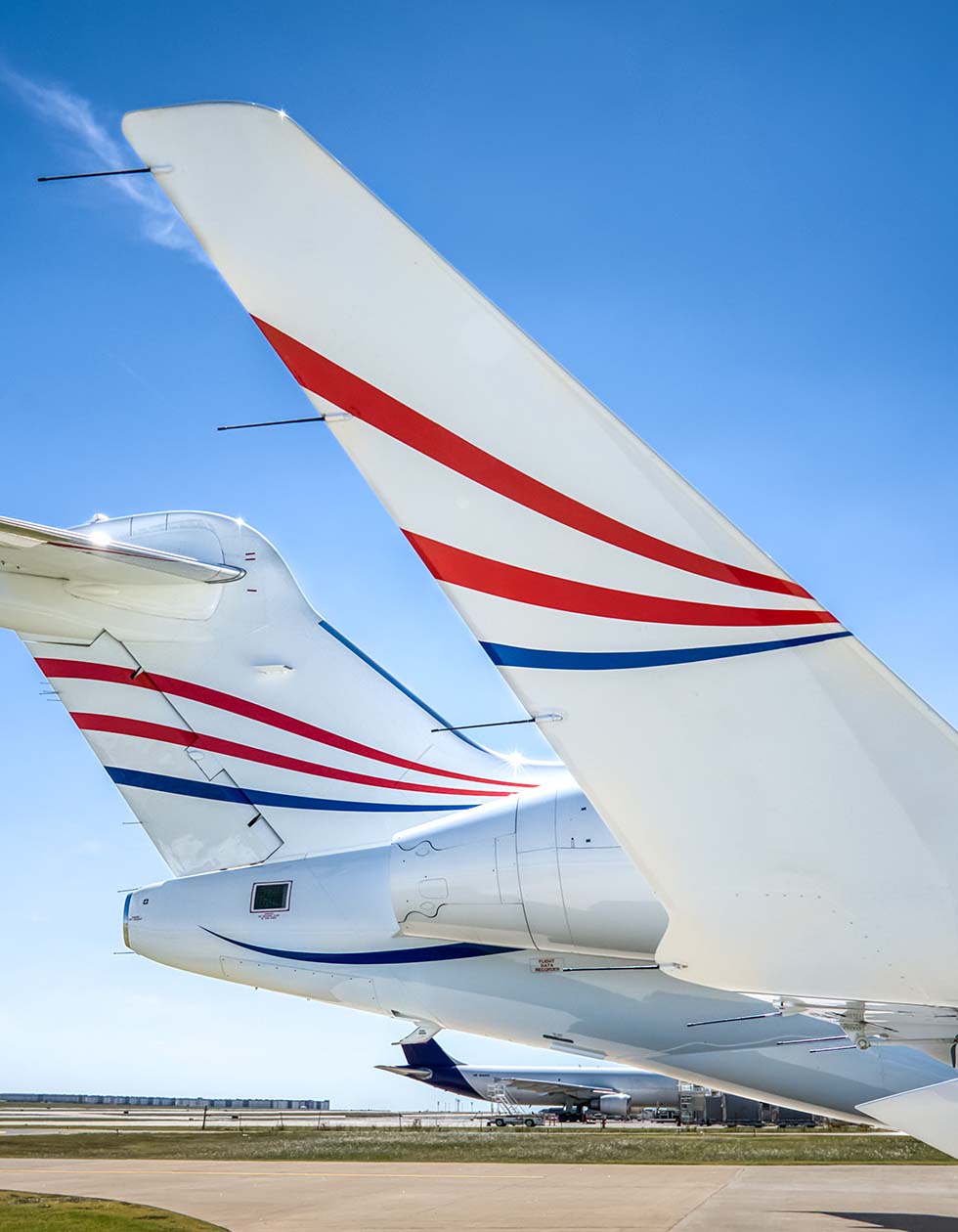

The Challenger 300, 350, and 605 often end up in the same conversation for buyers shopping the pre-owned market. But despite sharing the Challenger name, they’re not as interchangeable as they may first appear. All three share the Challenger family’s signature flat-floor, stand-up cabin, a loyal owner-operator base, and a reputation for dependable performance that has held up across three decades in service.
But “Challenger” doesn’t mean one aircraft with three trim levels. The 300 and 350 are two generations of the same super-midsize airframe. The 605 is a different aircraft entirely, larger in cabin, longer in range, and drawn from an earlier Challenger lineage, priced and operated on its own terms.
This is an $8M–$18.5M decision depending on model and vintage, with annual operating costs ranging from roughly $1.9M on a Challenger 300 or 350 to more than $3M on a Challenger 605, even when all three are flown the same number of hours a year. Buy more capability than your mission requires, and you’re funding it every flight hour for as long as you own the aircraft. Buy less, and you’ll eventually find yourself chartering supplemental lift to cover the trips your aircraft can’t make.
What follows isn’t a spec sheet comparison. It’s a practical breakdown of how these three aircraft differ in mission capability, operating economics, cabin space, and current pre-owned market conditions, so you can make a structured decision instead of a brand-driven one.
Challenger 300, 350, and 605: The Difference That Actually Drives the Decision
The Challenger 300 and 350 are two generations of the same super-midsize airframe, with the 350 offering more thrust, more range, and a taller cabin than the 300 it replaced. The Challenger 605 is a different aircraft, a larger-cabin, longer-range jet from the earlier Challenger 600 series, positioned above both in price and passenger capacity. Choosing among them comes down to how much cabin and range your mission actually requires, not which name sounds more current.
Bombardier certified the Challenger 300 in 2003 and built it for over a decade before replacing it with the Challenger 350 in 2014. The upgrade wasn’t cosmetic. The 350 swapped the 300’s Honeywell AS907 engines for the more powerful HTF7350, added roughly 20% taller cabin windows, and stretched usable range from around 3,100 nautical miles to the 3,200–3,400 nautical mile range depending on load and reserves. Both aircraft share essentially the same cabin footprint (roughly 25 feet 2 inches long, 7 feet 2 inches wide, 6 feet tall) with room for up to 10 passengers in a typical executive layout.
The Challenger 605 comes from a different branch of the family tree entirely. It’s a direct descendant of the original Challenger 600 and 604, certified in 2006 and produced through 2016. Its cabin runs closer to 28 feet long, 8 feet 2 inches wide, and 6 feet 1 inch tall, meaningfully larger than either the 300 or 350, with a maximum range around 4,000 nautical miles and cruise speeds up to Mach 0.82. It’s the aircraft to consider when your mission regularly needs more room, more range, or more passenger capacity than the super-midsize category comfortably provides.
Here’s the detail that surprises a lot of buyers: because the 605 has been out of production since 2016 and the 350 is still commanding strong demand as the newer, more efficient aircraft, a well-equipped pre-owned 605 often prices below a comparable 350, despite offering a noticeably larger cabin and longer range. That overlap is worth understanding before you assume the aircraft with the bigger cabin is automatically the more expensive purchase.
What Your Route Map and Passenger Load Tell You About Which Challenger to Buy
For short-to-medium missions carrying six to eight passengers, the Challenger 300 delivers strong economics at the lowest entry price in the family. The Challenger 350 earns its premium on missions that push toward the edges of transcontinental range or call for the newest cabin and avionics. The Challenger 605 is the right call when the mission regularly needs more cabin volume, passenger capacity, or intercontinental range than either the 300 or 350 can comfortably deliver, without stepping up to a Gulfstream or Global price point.
The business owners we work with tend to think about this in terms of utility per dollar, and that’s exactly the right frame. New York to Los Angeles, Chicago to Cancun, Dallas to Vail: the 300 and 350 handle domestic and regional missions like these with comfort to spare and the lowest hourly cost in the family. New York to London, Los Angeles to Hawaii, or a regularly full 10-passenger cabin start to make the 605’s extra range and space earn its keep.
The cleanest way to compare the three is at the same annual utilization, since the 300, 350, and 605 all get flown different amounts in the real world and that can make the gap look bigger or smaller than it actually is. Here’s what a consistent 400 flight hours a year looks like across all three:
- Challenger 300: roughly $3,000 per hour in direct operating cost, for an all-in annual budget of about $1.9M
- Challenger 350: roughly $3,200 per hour in direct operating cost, for an all-in annual budget of about $2.0M
- Challenger 605: roughly $5,500 per hour in direct operating cost, for an all-in annual budget of about $3.1M–$3.2M
The 300 and 350 land close together, and that’s expected. They’re built on the same airframe, and the 350’s more powerful Honeywell HTF7350 engines burn a bit more fuel, but the difference at the same utilization is a few hundred dollars an hour, not the wide gap it can look like when the two aircraft are compared at different annual hours. The 605 is where the real cost step-up happens: roughly $1.1M–$1.3M more per year than either super-midsize model, at the same 400 hours, which reflects its larger fuel burn, bigger crew and maintenance footprint, and higher-value airframe. That’s close to the cost of employing an additional flight department staff member.
There’s also a financial structure angle worth factoring into the timing of this decision. The return of 100% bonus depreciation, without phase-outs, continues to be one of the strongest tailwinds pulling business buyers into late-model aircraft in 2026, and it applies across the Challenger family regardless of which model fits your mission. If you’re weighing this acquisition as part of a broader business strategy, that’s a conversation worth having with your tax advisor alongside your acquisition team.
If your mission is trending toward a longer-range, larger-cabin trijet rather than a Challenger, our comparison of the Falcon 2000 and Falcon 900 covers that decision in detail. And if you’ve outgrown the Challenger family altogether, our guide on whether a Gulfstream is the right next step walks through how to evaluate that move honestly.
What Buyers Are Actually Finding in the Pre-Owned Challenger Market Right Now
As of mid-2026, the Challenger 300 has the deepest pre-owned inventory of the three, with active listings ranging from roughly $8M on early, higher-time examples to $13M on late-model, well-equipped aircraft. Challenger 350 inventory is comparatively thin, with pricing concentrated between $14M and $18.5M. The Challenger 605 sits in the middle on inventory but often prices below the 350 despite its larger cabin, with asking prices from about $9.5M to $16M depending on year, programs, and inspection status.
The Challenger 300 and 350 combined have seen more than 570 aircraft delivered since 2003, and that production history shows up directly in inventory depth. Buyers have real choice on the 300 in particular, but that also means differentiating between early and late examples matters more than chasing the lowest asking price, since engine hours, avionics, and program enrollment vary meaningfully across a decade-plus of production.
The 350 tells a different story. It remains one of the most in-demand aircraft in the super-midsize category, and clean, well-programmed examples don’t sit on the market long, which keeps asking prices firm even as broader pre-owned inventory has loosened in some categories.
The Challenger 605, with roughly 290 built between 2007 and 2016 and around 287 still in service, occupies an interesting position: it’s an older design, no longer in production, competing against newer super-midsize aircraft on price while offering meaningfully more cabin and range. For buyers optimizing cabin space and range per acquisition dollar rather than chasing the newest avionics suite, that makes the 605 worth a serious look.
Across all three, the same 2026 market dynamic applies: well-maintained, program-enrolled aircraft with current inspections and clean logbooks move quickly, and buyers without a technical evaluation team are the ones most likely to be surprised, either by a rushed decision or by what a deferred aircraft is actually worth. This is where Swartz’s differentiator earns its place. Licensed pilots and A&P mechanics on staff mean the technical evaluation isn’t outsourced, whether you’re comparing a dozen Challenger 300s or waiting on the right 605 to surface.
The Costs That Show Up After the Deal Closes
Purchase price is the most visible number in a Challenger acquisition. The maintenance exposure, program gaps, and avionics compliance issues that surface during and after the pre-purchase inspection determine whether the transaction was actually a good decision, and that exposure looks different across the 300, 350, and 605.
On the Challenger 300 and 350, the questions to ask center on:
- Engine program enrollment (MSP or ESP coverage on the Honeywell engines) and whether it transfers to a new owner
- Heavy inspection timing, including the 96-month and 192-month inspection cycles that show up frequently in current listings
- Avionics currency for international operations, including FANS 1/A+, CPDLC, and Link 2000+
- Connectivity upgrades like Gogo AVANCE or Starlink, which buyers increasingly expect and which affect how quickly an aircraft sells
On the Challenger 605, the exposure looks different, largely because the fleet is now 10 to 19 years old:
- Engine program enrollment on the GE CF34-3B engines, typically GE OnPoint or a comparable hourly cost program, and whether it transfers at closing
- Scheduled inspection and landing gear overhaul timing, which carries more weight on an aircraft this age than it does on a newer 300 or 350
- The same FANS 1/A+, CPDLC, and Link 2000+ compliance requirements for transatlantic and other international missions
- Interior and paint condition, since the 605 fleet is the oldest of the three and a full refresh is a five- to six-figure budget line that should be planned for, not discovered
None of this is meant to make any of these aircraft sound harder to own than they are. The Challenger 300, 350, and 605 are all well-supported platforms with deep parts availability and strong global service networks. The point is that a non-transferable engine program or an inspection due shortly after closing represents real exposure that a spec sheet or asking price won’t show, and buyers without a technical evaluation team often don’t find out until it’s too late to negotiate.
Aircraft Snapshot
| Challenger 300 | Challenger 350 | Challenger 605 | |
| Engines | 2x Honeywell AS907 | 2x Honeywell HTF7350 | 2x GE CF34-3B |
| Cruise speed | ~448–459 kt | ~459 kt (528 mph) | ~470 kt (Mach 0.80–0.82) |
| Range | ~3,100 nm | ~3,200–3,400 nm | ~4,000 nm |
| Cabin length | ~25 ft 2 in | ~25 ft 2 in (taller windows) | ~28+ ft |
| Cabin width/height | 7 ft 2 in / 6 ft | 7 ft 2 in / 6 ft | 8 ft 2 in / 6 ft 1 in |
| Typical pre-owned price | $8M–$13M | $14M–$18.5M | $9.5M–$16M |
Ready to Find the Right Challenger for Your Mission?
If you’re weighing the Challenger 300 against the 350, or considering whether a 605’s extra cabin and range are worth the tradeoffs, a current market report is the right starting point.
At Swartz Aviation, we bring licensed pilots and A&P-certified mechanics to every acquisition evaluation. The technical due diligence isn’t outsourced; it’s built into how we represent buyers on transactions like this.
► Request a Challenger Market Report →
Not ready for a full report yet? Set up a Challenger aircraft alert and we’ll notify you when the right aircraft hits the market.