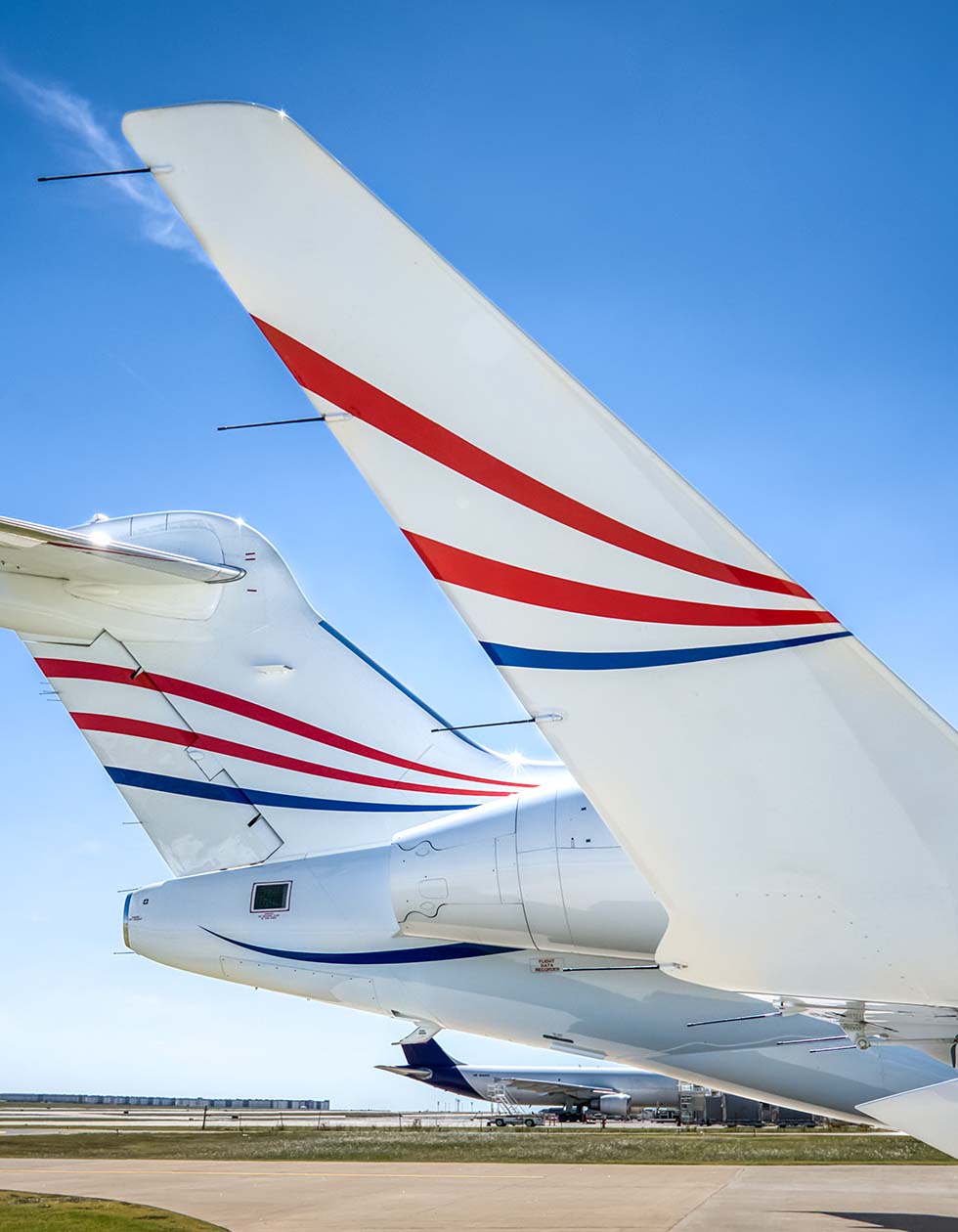

When you start looking at a Falcon 2000, it’s pretty natural to take a look at the Falcon 900 too. These two aircraft share the same French engineering heritage, the same wide-body cabin cross-section, and a loyal operator base that has flown both platforms for decades. On paper, the comparison looks close. In practice, the right choice depends almost entirely on how you actually use the aircraft.
This is a $4M–$15M decision in today’s pre-owned market, with annual operating costs that can range from roughly $1.5M to $3.5M or more depending on variant, utilization, and maintenance program status. Choosing the wrong platform doesn’t just cost money at purchase. It costs money on every flight for as long as you own it.
What follows isn’t a spec sheet comparison. It’s a practical breakdown of how these two aircraft differ in mission capability, operating economics, cabin utility, and current market conditions, so you can make a structured decision instead of an emotional one.
The Difference That Actually Drives the Decision
The Falcon 2000 and Falcon 900 are not interchangeable aircraft. The 2000 is a twin-engine large/super-midsize jet built for transcontinental range with efficient economics. The 900 is a trijet with longer range, higher passenger capacity, and superior short-field flexibility, at meaningfully higher operating costs. The right choice depends on mission profile, not brand preference.
The Falcon 2000 was developed directly from the Falcon 900 in the early 1990s. Dassault shortened the fuselage by seven feet, removed the third engine, and redesigned the wing, creating an aircraft optimized for the U.S. coast-to-coast market and beyond. The result is a more economical platform with strong transcontinental range that’s attracted generations of owner-operators and corporate flight departments.
The Falcon 900, by contrast, kept its trijet configuration through successive variants. That third engine isn’t redundant for its own sake. It unlocks capabilities the twin-engine 2000 can’t replicate. The 900LX reaches approximately 4,750 nautical miles, supporting true transatlantic city pairs like New York to London or Los Angeles to Tokyo. It also delivers more payload and offers access to shorter or higher-altitude airports that challenge a twin-engine aircraft at max weight.
The 2000LXS, the current production variant, comes in around 4,000 nautical miles, enough for most transatlantic routes and virtually any domestic or regional international mission. For operators whose routes don’t regularly require the 900’s extended reach, the 2000 delivers comparable performance at lower cost.
The cabin tells a similar story. The Falcon 900’s interior is approximately seven feet longer than the 2000. That difference is real on a six-hour flight with eight passengers. The 2000’s cabin is well-appointed and efficient, and it performs exceptionally well for groups of eight or fewer on shorter missions. But if your typical flight is transatlantic with a full passenger load, the 900’s additional space justifies its operating cost premium.
What Your Route Map Tells You About Which Falcon to Buy
For most U.S.-based business operators flying domestic and select international routes, the Falcon 2000 delivers the required range at lower operating costs per hour. The Falcon 900 earns its premium when the mission regularly requires true long-range intercontinental capability, high-altitude airport access, or maximum passenger capacity.
The business owners we work with most often think about this decision in terms of utility per dollar, and that\u2019s is exactly the right frame. An aircraft that’s overpowered for your typical mission is expensive every time it flies. One that can’t reliably complete the mission without a fuel stop is a different kind of expensive.
Here’s a practical way to think it through: if your most common routes are within the continental U.S., or include transatlantic hops to Europe from the East Coast, the Falcon 2000LXS handles those missions with comfort to spare. If you’re regularly flying New York to the Middle East, or Los Angeles to Asia, the Falcon 900’s extended range and trijet configuration starts to make a stronger case.
There’s also a financial structure angle worth considering. The return of 100% bonus depreciation with no phase-outs has been one of the strongest economic tailwinds in the 2026 pre-owned market, pulling many business buyers forward who might otherwise have waited. If you’re evaluating an aircraft acquisition as part of a broader financial strategy, the economics favor acting in the near term. That’s a conversation worth having with your tax advisor alongside your acquisition team.
If you’re also weighing how aircraft management affects the total cost picture once you own, our blog on How Professional Aircraft Management Saves Owners Time and Money breaks that down in detail.
What Buyers Are Actually Finding in the Pre-Owned Falcon Market Right Now
As of mid-2026, the pre-owned Falcon 2000 market has approximately 34 active listings with pricing ranging from roughly $1.9M to $8.9M depending on variant, year, and maintenance status. The Falcon 900 market shows approximately 24–26 listings with an average asking price around $8.9M and a range of $4.5M to $23M. Both markets are operating under tight inventory conditions that favor sellers on well-maintained, program-enrolled aircraft.
Those listing numbers don’t tell the full story. Total pre-owned business jet inventory has dropped to approximately 4% of the global fleet, well below the 10% threshold that historically defines a balanced market. Supply is tight, demand from both individual and corporate buyers remains strong, and late-model aircraft with clean histories are transacting quickly and with limited price flexibility.
What that means practically is that two Falcon 2000s listed at the same price can represent dramatically different value propositions. Engine program enrollment (or lack of it), upcoming 1C/2C inspection timing, avionics compliance for international operations, and single vs. multiple ownership history all move the number, sometimes significantly. A 2001 Falcon 2000 currently listed at $4.795M with MSP Gold, a fresh 1C/2C check, and a Head Up Display is a very different aircraft from a similarly-priced example with non-programmed engines and a heavy inspection coming up in the next 12 months.
The same dynamic applies on the 900 side. Falcon 900EX and 900LX variants with MSP Gold, recent 2C and gear overhaul completions, and current FANS 1/A+ CPDLC capability command firm pricing. Buyers who don’t have a technical team evaluating maintenance program transferability and inspection exposure are routinely surprised after the deal closes.
For buyers considering the pre-owned process more broadly, our blog on The Process of Buying a Pre-Owned Jet: What to Expect walks through exactly what a well-run acquisition looks like from search through closing.
The Costs That Show Up After the Deal Closes
Purchase price is the most visible number in a Falcon acquisition. The maintenance exposure, program gaps, and avionics compliance issues that surface during and after the pre-purchase inspection determine whether the transaction was actually a good decision.
Here’s what we see catch buyers off guard most often on both platforms:
Engine program gaps. MSP Gold enrollment is common on well-maintained Falcons, but not universal, and non-programmed engines carry significant cost exposure. Even more important: some programs are not transferable to a new owner, which means a listed aircraft that appears program-enrolled may not transfer that coverage at closing. A buyer without technical support on the inspection team frequently misses this.
Upcoming heavy inspections. The 1C, 2C, 3C, and gear overhaul cycles on Falcon aircraft are expensive and time-intensive. An aircraft priced attractively may be priced to reflect an upcoming 2C inspection that will cost $300K–$600K or more. That’s not a problem if you know about it and it’s reflected in the purchase price. It’s a problem when it isn’t.
Avionics compliance. FANS 1/A+ and CPDLC are required for transatlantic and certain international operations. WAAS/LPV matters for domestic approaches. Aircraft without these upgrades are functional domestically but operationally limited for international missions, and retrofitting them adds cost and downtime that buyers often don’t anticipate.
Deferred interior and paint. A 10-year-old interior on a Falcon 2000 or 900 that hasn’t been refreshed isn\u2019t a cosmetic issue. It\u2019s a budget line item. Refurbishment costs vary widely, but a full interior and paint project on an aircraft of this caliber routinely runs $500K–$1M+. That’s a number that should be in the acquisition budget from day one.
None of this is meant to make the acquisition sound harder than it is. The Falcon 2000 and 900 are outstanding, well-supported aircraft with deep parts availability and a global service network. The point is that buying one well requires a technical evaluation team that knows what to look for, not just a broker who can move paper.
IADA-member dealers and brokers operate under a code of ethics that governs transparency and disclosure. That matters when you’re navigating a market where the best aircraft frequently change hands off-market and where representation quality varies significantly.
Ready to Find the Right Falcon for Your Operation?
If you’re evaluating the Falcon 2000 against the 900, or narrowing in on a specific variant and want a clear read on what\u2019s available, what it should cost, and what to watch for, a current market report is the right starting point.
At Swartz Aviation, we bring licensed pilots and A&P-certified mechanics to every acquisition evaluation. The technical due diligence isn’t outsourced; it’s built into how we represent buyers in transactions like this.
► Request a Falcon Market Report →
Not ready for a full report yet? Set up a Falcon aircraft alert, and we’ll notify you when the right aircraft hits the market.
► Set Up a Falcon Aircraft Alert →